
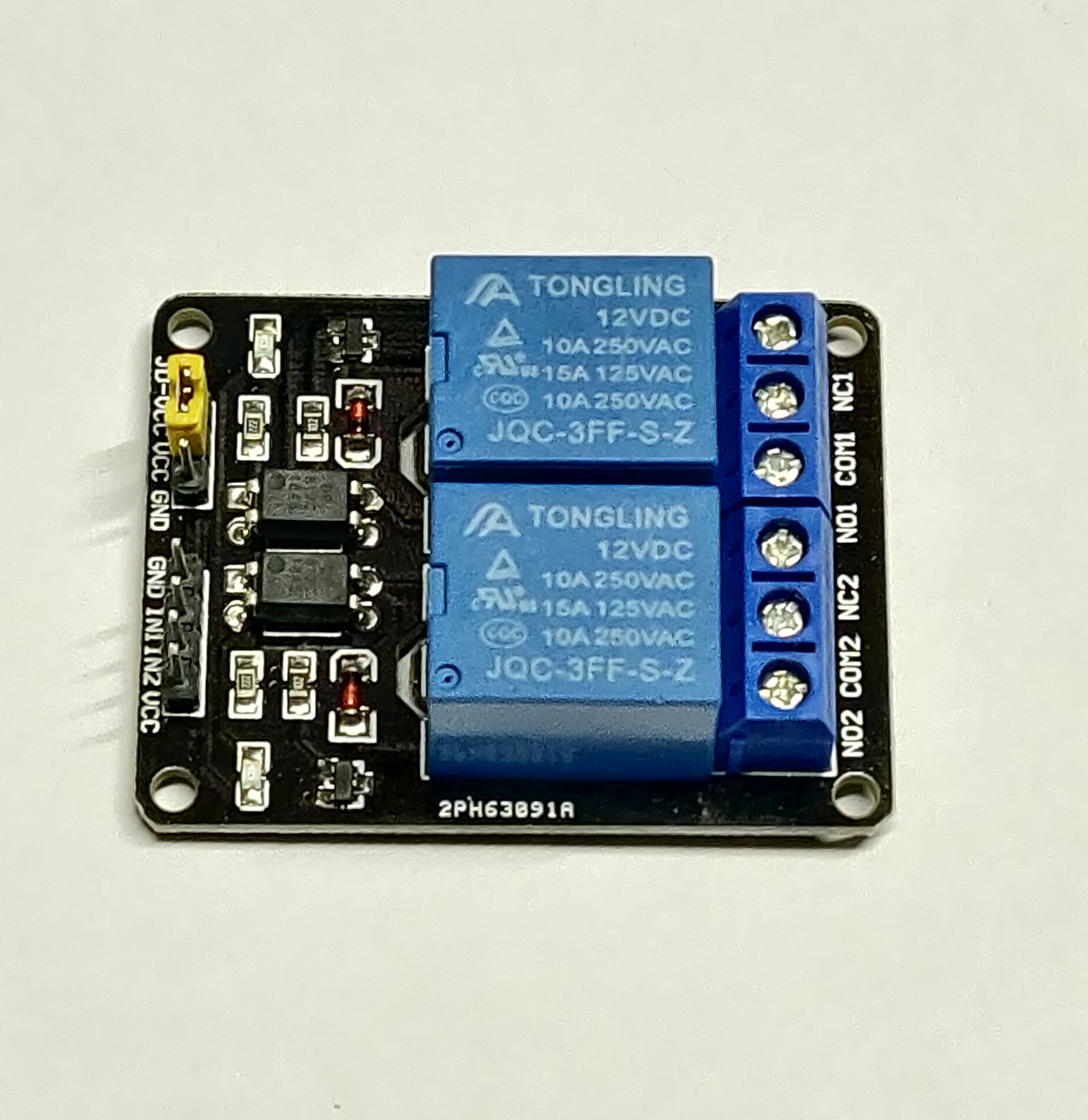
Description
The 12V Dual Channel Relay Module is an electronic interface board that enables a low-power control circuit (like a microcontroller or Arduino, typically $3.3 \text{V}$ or $5 \text{V}$) to independently switch and control two separate high-power electrical circuits or appliances.
Key Features
12V Coil Voltage: The relays themselves require a $12 \text{V}$ DC supply to energize their electromagnetic coils. The module often has a separate $VCC/GND$ input for this power.
Dual Channel: Contains two separate, isolated relays, allowing two distinct loads (e.g., a light and a motor) to be controlled.
Control/Trigger Voltage: Accepts low-voltage signals (usually $3.3 \text{V}$ or $5 \text{V}$) on its $\text{IN1}$ and $\text{IN2}$ pins, making it compatible with most microcontrollers.
High Load Capacity: Each relay typically has screw terminals ($\text{COM}$, $\text{NO}$, $\text{NC}$) capable of switching high-power loads, often rated for $10 \text{A}$ at $250 \text{V AC}$ or $30 \text{V DC}$.
Isolation: Many modules include an optocoupler for electrical isolation, protecting the sensitive microcontroller from voltage spikes or high voltage/current noise from the switched load.
Main Purpose
It acts as an electrically operated switch, providing a safe and effective way to use low-voltage digital signals to turn on/off high-voltage or high-current devices in applications like home automation, robotics, and industrial control systems.


Reviews
There are no reviews yet.