

Description
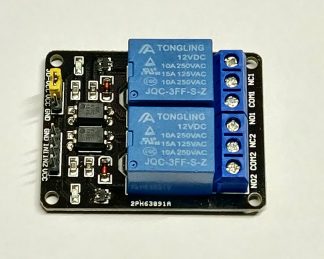
The 5V 4 Channel Relay Module is an interface board that allows a low-voltage microcontroller (like Arduino or Raspberry Pi, which use $5 \text{V}$ or $3.3 \text{V}$ logic) to safely and independently control up to four separate high-power electrical devices or circuits.
Key Specifications
Channels: Four independent relays, enabling control of four different loads.
Coil Voltage: The relays operate using a $5 \text{V}$ DC power supply (often shared with the microcontroller, though separate power can be used for isolation).
Control/Trigger: Uses low-voltage digital signals (typically $5 \text{V}$ or $3.3 \text{V}$) on its $\text{IN}$ pins to activate the relays.
Load Capacity: Each relay is typically rated to switch high-power loads, commonly up to $10 \text{A}$ at $250 \text{V AC}$ or $30 \text{V DC}$.
Isolation: Often includes optocouplers for electrical isolation, which protects the sensitive microcontroller from dangerous voltage spikes and electrical noise generated by the high-power loads.
Main Purpose
It serves as the essential bridge between the low-power digital world of microcontrollers and the high-power world of household appliances, motors, lights, and other AC or high-current DC devices, making it a cornerstone component for home automation and robotics projects.

Reviews
There are no reviews yet.